As I was checking a few of my facts for a paper, I happened across a biography of Glenn Doman - with two dates. Wait, what? As in, J.S. Bach 1685-1750. My biography only has one date...
Suddenly my world was in shock.
I have cited Glenn Doman in nearly every paper I've written remotely related to development or education in the last seven years. Usually, I don't even have to check the publishing stats, but I don't trust my brain and like to double check. I have never met Glenn Doman in person - only through his writing; and yet I felt as if I had just lost a mentor. Serious doubts exist as to whether I would be involved in music at all if not for this mentor author.
In high school, I discovered an old book Doman had written chronicling his work in neurologically based physical therapy (What to do About Your Brain Injured Child). I was hooked. The idea of Frequency, Intensity, and Duration as the key components of neurological pathway development and regeneration would haunt me - and eventually get me through college.
Throughout my school years - elementary, middle school - it was evident I had learning disabilities; but being the stubborn (or the world I like - tenacious) child I was, my compensation skills kept me from exposing the extent to which those disabilities affected me. But all that compensating caught up with me in college and the roller coaster began.
In all my tenacious brilliance, I had become a music major. That life plan crashed and burned - pretty literally. I hit a reinforced cement blockade with razor wire decorating the top. What I didn't know was the name of my blockade; sight reading struggles were really named dyslexia (yep, you CAN read music backwards - and I did), and instead of 'lazy practicing,' my intonation issues were "auditory processing delay;" The razor wire consisted of some pinched nerves in my neck, making my practice time not only ineffective but excruciatingly painful. But I didn't know any of that. Clearly, this wasn't working - and I quit.
The problem was, you can't quit who you are. A little physical therapy cleared away the razor wire, but the other issues were not so obviously addressed. I kept going, kept learning, but my interest in neurology began dominating my research time - which was a good thing. As I re-read What to Do, a comment about infant auditory reflexes exploded my world; I was twenty-one years old and still reacting to aural stimulus in a reflexive manner. That couldn't be right. But it was.
With crude instruments (a metronome, tuner, and cell phone camera) I started timing my auditory responses and reactions in the practice room. The numbers were indicative of an auditory processing delay. Not a deficiency, just a delay. Some neural pathways were having trouble communicating, and my dyslexia wasn't helping. Back to the books.
Once again, it was Doman with the light bulb moment. Frequency, Intensity and Duration became my practice room motto as I taught myself how to learn. By breaking down music into smaller pieces, I was able to triple the frequency of repetitions; playing scales slower and louder, the auditory stimulus was intensified and the duration extended. Everyone forced to listen through the thin practice walls thought the scale infatuated chic was nuts, but it started working. My practice sessions were longer, slower, and annoyingly repetitive - and at the end of the semester, my processing speed had almost doubled.
Just in time to pass my juries.
There I was, still researching and writing about my pet topic of neuro-therapy and education, but reading those two dates lined up on my computer screen brought my productivity to a halt. Glenn Doman had only mentored me through his books, but they changed my life. His stories had shown that anything is possible, even when the word 'disability' describes the struggle to get there. The struggle is real, but it doesn't define anyone.
Thank you Dr. Doman, for the inspiration to overcome.
Thursday, August 11, 2016

Saturday, July 16, 2016
The Meaning of 'Rote' - An Impassioned Definition
As I work through my masters program, the topic of rote memorization is continually being referenced as the ultimate failure in education. And I've had enough.
Maybe it's because I'm a music teacher, but I just can't relate. How is knowing all 36 scales in your sleep a bad thing? Or having the times tables so automatic it's faster to do long multiplication than to put forth the effort and find the calculator? According to the popular theories of learning, because these things were learned by rote, the concepts they represent were not understood and therefore meaningful learning failed to take place. I beg to differ...
Again, maybe it's because I'm a music teacher.
The problem is not rote memory, the problem lies in abandoning rote memory to fend for itself in the tangles of the neurological forrest. Hiking in the wilderness is fun and exciting... and healthy. Getting lost is not.
I am convinced - by both experience and research - that rote learning is foundational to conceptual learning. Rote memory leads to understanding... if you stay on the trail. Any student of mine (or any Suzuki student, for that matter) will tell you the very first thing they learn is Twinkle Twinkle Little Star. Parents learn to hate that song - because students learn it by rote; just like the ABC song and the word 'no.' And just like the first time a child mimics the word 'dog,' they have no idea of the musical implications or meaning of what they have just played and said. At this point in their musical career, they know Twinkle, but they don't KNOW Twinkle or WHY Twinkle. There is a neurological pathway labeled Twinkle connected with body coordination, words, and rhythm - all concrete. There are no abstract interconnecting pathways. Just one lonely pathway in a tangle of neurons.
Now we spiral. The one lonely neuron has just coordinated finger dexterity; the student's brain is finally free to shift focus. If the student and teacher continue on the metaphorical trail, new concepts - such as musical notation, intervals, etc. - are introduced and added to what the student already knows - Twinkle Twinkle Little Star. A teacher intent on traveling down the path of understanding guides the student three steps down the path, only to back up two steps and make connection, build pathways. The only reason those steps are there to compare is because of rote memory. As concepts are applied and new pathways built, the rote memory of Twinkle becomes a vast network of finger mapping, half and whole steps, tonality, perfect fifths and fourths, binary form, phrasal contour, cadencial emphasis... need I go on? What was once rote memory becomes a complex understanding of the musical world - attached to a melody that students can't forget. Rote memory has become deep memory.
Learning all 36 scales is painful. They are initially learned by rote. Eventually, the math and theory behind the construction of the various scales starts to make sense within the context of rote memory; the memory becomes meaningful, and subsequently unforgettable. But in order to understand the theory of the scale, I needed to understand half and whole steps. To understand half and whole steps, I had to feel and hear half and whole steps - which was done through rote imitation of my teachers. The process is similar for the times tables - rote memory, followed by concept development leads to deep, accessible memory. It is impossible to forget what 2x2 is - but rote came first.
Here lies the problem: many have made the assumption that if a student can supply the desired response (scales) or answer (times tables), they must therefore understand what they have done. Not so. Rote answers precede understanding; they are not diagnostic of understanding. When rote memory is confused with understanding, spiral concept development is abandoned as the teacher races ahead through the forest of abstract concepts. The rote memories of students are left to wander off the trail only to be lost in the dense tangle of neurons, never to be accessed again. Deep memory never forms and the rote pathways are recycled for more pertinent memories. When teaching and learning stop after rote memory has been achieved, learning does not take place.
I contend that this is not rote learning; this is an attempt to cheat the system. When master teachers were observed using rote memory with great success, the fallacious conclusion was reached that rote memory was an end in itself. Why spend so much time teaching scales when they can simply be memorized? Rote has come to mean 'merely memorized.' This is not rote learning - it is rote faking.
So please - do not confuse my rote learning with your rote faking.
True rote learning leads to deep memory. This appears to be a familiar concept to musicians; maybe the rest of the educational world just needs time to catch up with what we already know. Maybe the arts initiative and our new status as a 'real' school subject will give us the opportunity to differentiate between real rote and fake rote... I can dream, can't I?
Maybe it's because I'm a music teacher, but I just can't relate. How is knowing all 36 scales in your sleep a bad thing? Or having the times tables so automatic it's faster to do long multiplication than to put forth the effort and find the calculator? According to the popular theories of learning, because these things were learned by rote, the concepts they represent were not understood and therefore meaningful learning failed to take place. I beg to differ...
Again, maybe it's because I'm a music teacher.
The problem is not rote memory, the problem lies in abandoning rote memory to fend for itself in the tangles of the neurological forrest. Hiking in the wilderness is fun and exciting... and healthy. Getting lost is not.
I am convinced - by both experience and research - that rote learning is foundational to conceptual learning. Rote memory leads to understanding... if you stay on the trail. Any student of mine (or any Suzuki student, for that matter) will tell you the very first thing they learn is Twinkle Twinkle Little Star. Parents learn to hate that song - because students learn it by rote; just like the ABC song and the word 'no.' And just like the first time a child mimics the word 'dog,' they have no idea of the musical implications or meaning of what they have just played and said. At this point in their musical career, they know Twinkle, but they don't KNOW Twinkle or WHY Twinkle. There is a neurological pathway labeled Twinkle connected with body coordination, words, and rhythm - all concrete. There are no abstract interconnecting pathways. Just one lonely pathway in a tangle of neurons.
Now we spiral. The one lonely neuron has just coordinated finger dexterity; the student's brain is finally free to shift focus. If the student and teacher continue on the metaphorical trail, new concepts - such as musical notation, intervals, etc. - are introduced and added to what the student already knows - Twinkle Twinkle Little Star. A teacher intent on traveling down the path of understanding guides the student three steps down the path, only to back up two steps and make connection, build pathways. The only reason those steps are there to compare is because of rote memory. As concepts are applied and new pathways built, the rote memory of Twinkle becomes a vast network of finger mapping, half and whole steps, tonality, perfect fifths and fourths, binary form, phrasal contour, cadencial emphasis... need I go on? What was once rote memory becomes a complex understanding of the musical world - attached to a melody that students can't forget. Rote memory has become deep memory.
Learning all 36 scales is painful. They are initially learned by rote. Eventually, the math and theory behind the construction of the various scales starts to make sense within the context of rote memory; the memory becomes meaningful, and subsequently unforgettable. But in order to understand the theory of the scale, I needed to understand half and whole steps. To understand half and whole steps, I had to feel and hear half and whole steps - which was done through rote imitation of my teachers. The process is similar for the times tables - rote memory, followed by concept development leads to deep, accessible memory. It is impossible to forget what 2x2 is - but rote came first.
Here lies the problem: many have made the assumption that if a student can supply the desired response (scales) or answer (times tables), they must therefore understand what they have done. Not so. Rote answers precede understanding; they are not diagnostic of understanding. When rote memory is confused with understanding, spiral concept development is abandoned as the teacher races ahead through the forest of abstract concepts. The rote memories of students are left to wander off the trail only to be lost in the dense tangle of neurons, never to be accessed again. Deep memory never forms and the rote pathways are recycled for more pertinent memories. When teaching and learning stop after rote memory has been achieved, learning does not take place.
I contend that this is not rote learning; this is an attempt to cheat the system. When master teachers were observed using rote memory with great success, the fallacious conclusion was reached that rote memory was an end in itself. Why spend so much time teaching scales when they can simply be memorized? Rote has come to mean 'merely memorized.' This is not rote learning - it is rote faking.
So please - do not confuse my rote learning with your rote faking.
True rote learning leads to deep memory. This appears to be a familiar concept to musicians; maybe the rest of the educational world just needs time to catch up with what we already know. Maybe the arts initiative and our new status as a 'real' school subject will give us the opportunity to differentiate between real rote and fake rote... I can dream, can't I?
Monday, May 23, 2016
Making Music with a Metal Allergy
When you have a severe metal allergy, playing certain instruments presents an itchy challenge. While I crave making music, it simply wasn't worth the fluid filled blisters and swelling around my face.
 For the brass family, there are these wonderful beauties - Kelly mouthpieces. Fully plastic and fully hypoallergenic.
Stainless Steel mouthpieces are available, but less than budget friendly.
 Flutes are more complicated than the brass family - and no, plastic lip plates are not a thing. But Blue Painter's tape is!

 Depending on how severe the allergy is, more of the head joint can be covered with tape, as well as other points of contact with the hands.
Blue painters tape doesn't leave a residue, and the beautiful part is - the effect on sound is minimal.
I have found that I am more sensitive to different alloys - I don't need to cover this much of the head joint when using solid silver, but nickle causes a reaction with mere proximity... no contact required!
Nuvo and Allora plastic instruments are new options for the metallic challenged musicians. Stainless steel is a highly hypoallergenic alloy, but unfortunately, at a high cost when it comes to instruments.
But the good news is... there are options! A metal allergy need not determine what methods of music making are open to you!
If you have found other solutions, I would love to hear about them! Leave a comment with your blue (or any other color) solutions.
So what's a musician to do? Not play metal instruments? NEVER!
There are solutions - maybe not conventional looking solutions, but solutions nonetheless.
Here are the budget friendly solutions I have found when gold and silver didn't make the hypoallergenic list - and they work!

Stainless Steel mouthpieces are available, but less than budget friendly.
 Flutes are more complicated than the brass family - and no, plastic lip plates are not a thing. But Blue Painter's tape is!
By creasing a piece of wide tape around the edges of the lip plate, you can cut a close fitting cover...

Blue painters tape doesn't leave a residue, and the beautiful part is - the effect on sound is minimal.
I have found that I am more sensitive to different alloys - I don't need to cover this much of the head joint when using solid silver, but nickle causes a reaction with mere proximity... no contact required!
Nuvo and Allora plastic instruments are new options for the metallic challenged musicians. Stainless steel is a highly hypoallergenic alloy, but unfortunately, at a high cost when it comes to instruments.
But the good news is... there are options! A metal allergy need not determine what methods of music making are open to you!
If you have found other solutions, I would love to hear about them! Leave a comment with your blue (or any other color) solutions.
Thursday, May 5, 2016
The MYELINATOR
Yes, I made that word up.
This is the single most useful thing to have in a practice room - and not just for my students! As an ADDer, this awkward little contraption helps me stay on track when I'm working sections of a piece - because "SHINY!" happens quite frequently in my practice room.
You see correctly -
- two clothes pins
- one tiny dowel (1/8 inch I believe)
- 15 large beads
- and a lot of hot glue
It can clip to a music stand, a book, rest on top of a piano - it's basically a music room abacus.
But what do you do with it?
It counts the number of repetitions done while chunk practicing. The beads slide across to the opposite side of the dowel each time you play a chunk of music - CORRECTLY. Only when the repetition was done correctly does the bead get to move across. This sounds simple, but is incredibly difficult to do 15 times correctly.. and then in a row.
The magic behind FIFTEEN:
There is something about the number 15 that is magical in a practice room - or when you are learning any other skill for that matter. The first five consecutive times you do something will be laborious and painstaking - or just annoying. The second set of five repetitions will go significantly smoother - until you hit number 10. Right around the tenth rep, something snaps. The chunk you have just played successfully 9 times in a row simply will not be played. Just when you thought you had it, your brain disengages, it disappears and you have to slow down again to regain control - and reengage your brain. But it's when you push past that wall to play a third set of five that big learning happens. The battle has been waged, but this time won. When you come back to that section the next day, thes ease with which it comes back into your fingers (or mouth) evokes an involuntary sigh of relief. It stuck!
Don't believe me? Try it! Grab a piece of music (something that furrows your brow, not that piece from three years ago...) and try to play even 11 times - in a row - without crashing. Keep in mind, you won't notice what is going on if you have been practicing already; the wall will be far too subtle. To experience face-planting into the 10 rep wall, use material that is at the far reaches of your ZPD (zone of proximal development). Is this not painful? And sad, how accurate the math can be...
Learning is greatly accelerated when we push past the moment when the brain has shut down and move into intentional learning. This is where having a learning disability has made me keenly aware of the learning process; my brain needs more reps in varied contexts to turn practice into skill. Having the visual of the myelinator became incredibly helpful in giving my brain what it needed to learn.
Somewhere out there is research on why the brain responds this way after 15 repetitions. But that is what google.scholar is for. To quote Dr. Suzuki: "Knowledge is not skill. Knowledge plus ten thousand times is skill." It takes around two years to do something ten thousand times - if you do it 15 times a day. Skill is being able to do something correctly without even thinking about it. With these numbers, the skill becomes part of you - cognition not required. Is it any wonder musicians describe music as being part of who they are? They may not realize what is going on, but the act of music is being woven into the fabric of their brain and becoming part of their being.
This is the single most useful thing to have in a practice room - and not just for my students! As an ADDer, this awkward little contraption helps me stay on track when I'm working sections of a piece - because "SHINY!" happens quite frequently in my practice room.
 |
| The Melinator... |
- two clothes pins
- one tiny dowel (1/8 inch I believe)
- 15 large beads
- and a lot of hot glue
It can clip to a music stand, a book, rest on top of a piano - it's basically a music room abacus.
But what do you do with it?
It counts the number of repetitions done while chunk practicing. The beads slide across to the opposite side of the dowel each time you play a chunk of music - CORRECTLY. Only when the repetition was done correctly does the bead get to move across. This sounds simple, but is incredibly difficult to do 15 times correctly.. and then in a row.
The magic behind FIFTEEN:
There is something about the number 15 that is magical in a practice room - or when you are learning any other skill for that matter. The first five consecutive times you do something will be laborious and painstaking - or just annoying. The second set of five repetitions will go significantly smoother - until you hit number 10. Right around the tenth rep, something snaps. The chunk you have just played successfully 9 times in a row simply will not be played. Just when you thought you had it, your brain disengages, it disappears and you have to slow down again to regain control - and reengage your brain. But it's when you push past that wall to play a third set of five that big learning happens. The battle has been waged, but this time won. When you come back to that section the next day, thes ease with which it comes back into your fingers (or mouth) evokes an involuntary sigh of relief. It stuck!
Don't believe me? Try it! Grab a piece of music (something that furrows your brow, not that piece from three years ago...) and try to play even 11 times - in a row - without crashing. Keep in mind, you won't notice what is going on if you have been practicing already; the wall will be far too subtle. To experience face-planting into the 10 rep wall, use material that is at the far reaches of your ZPD (zone of proximal development). Is this not painful? And sad, how accurate the math can be...
Learning is greatly accelerated when we push past the moment when the brain has shut down and move into intentional learning. This is where having a learning disability has made me keenly aware of the learning process; my brain needs more reps in varied contexts to turn practice into skill. Having the visual of the myelinator became incredibly helpful in giving my brain what it needed to learn.
Somewhere out there is research on why the brain responds this way after 15 repetitions. But that is what google.scholar is for. To quote Dr. Suzuki: "Knowledge is not skill. Knowledge plus ten thousand times is skill." It takes around two years to do something ten thousand times - if you do it 15 times a day. Skill is being able to do something correctly without even thinking about it. With these numbers, the skill becomes part of you - cognition not required. Is it any wonder musicians describe music as being part of who they are? They may not realize what is going on, but the act of music is being woven into the fabric of their brain and becoming part of their being.
Saturday, April 30, 2016
Up the Sleeve - Tricks of my Trade
Practicing - especially the chunked way - can be a real drag for students still getting used to the routine; seeing the benefits can take awhile, and even then it can feel like trudging through mud.
While it's true that making music isn't all fun and games, there's no reason for it to stay that way! Here is one of my favorite ways to liven up chunk-practicing - with a card game.

Voila! With a dash of my conductors baton, these nifty pre-cut cards are now practice cards.

Your music is marked and your students have listened and discussed why the phrases have names... now for the cards.
The cards now get a makeover: using a sharpie, each phrase gets a card named after itself.
The simple version of this card game is to shuffle and have the student pick a card... any card. Ok, now we chunk practice the section named on the card 5 times using....
The Myelinator:

Kinda like an abacus, but for counting practice repetitions. Fancy, I know...
The process is repeated through the rest of the cards.
Now you can put the cards in order and play the whole thing!
Having the parts of the music mixed up aids learning by removing context cues - students must know the section as a section and not merely as the middle of the song. This is great for memorizing - the cards can be used like flashcards, but for phrases. When it comes time for performances, freezing on a given phrase is no longer the end of the show - the student can simply choose a phrase and keep going. Because the phrases were practiced out of context, their performance doesn't depend on the previous phrase going well.
Practice brain wise! And with a fun twist :)
I imagine 'Go Fish' could be incorporated somewhere in all of this...
Sunday, November 1, 2015
Neuro Music - A Tour of a Brain on Music
“Hey!
Look!”
“Over
there!”
“Oooh…
Look!”
“What is
it?”
“How should
I know?”
“What? You
mean THAT?”
“Let’s ask
Thy.”
“It’s Thy’s
break time – better ask Hypo, he’s in charge tonight.”
“Hyp! Hey
Hyp! Over here!” “Help us out Hypothalamus”
“What are
all you crazy AP’s going off about? Don’t you know its break time?”
“Gee, Hyp,
don’t blame us! We’re voluntary – she’s imagining this whole thing.”
“Right.
Well – IT’S DARK! Stop it! You’re throwing off my circadian rhythm!”
“I think
they are here for a tour…”
Sometimes my imagination
gets the jitters at night. This particular incident that you are witnessing
involves the rational for my obsession with music – and the neurological
effects of music on education and disabilities. It’s a mouthful, isn’t it? What
a crazy profession, music. I happen to be one of those believers who think
every child can learn to make music, regardless of anything standing in their
way; as a matter of fact, I have had a few things stand in my way. Enough for
some folks to think I should not be standing here and enough for others to
kindly deem me ‘persistent.’ But, hey! As long as we are here, why not join me
for the tour of a brain on music?
“The tour, eh? Gee… well, I guess I could take you on the
five-cent look around. Uh-Hmm. First, the introductions. I am Hypothalamus, in
charge of the pharmacy and sleep… and a few other things, of course. Not many
of us up here have simple jobs; why most of us have entire books – “
“Hyp, I think they are here for the music tour – you know, how music has affected our functions?”
“Right, thank you Glia. Now then, follow me… A few more short
introductions while we walk – Neuroglia here works in communications, between
synapses that is, along with the AP’s. The Action Potentials you already met.
They keep this place bouncing. Glia, do try keeping those AP’s in their place.
Somewhere they can’t distract me...”
“Ummm…”
“I know, not your job. Basal Ganglia hasn’t been keeping up with
the demand for dopamine and serotonin, so Pre Frontal Cortex is running a
little inattentively… along with a few of the other lobes. Well, Glia, we shall
just do the best we can, and if I get off topic, just give me a zap.”
“Now that I can do.”
(If Hyp over there has lost
you – I have ADD. ‘Inattentive’ does not mean I can’t focus; it means I focus
on everything - so things stay pretty interesting around here. Synapses
communicate through electrical signals, which neuroglia helps conduct; Glia is
well acquainted with shocking intervention.) Hyp, where are we going?
“Glad you asked – the inner ear. No, we’re not ‘hear’ to see the stirrup and
anvil – look past the cochlea.

"See that big bundle of nerves? That is the auditory nerve;
if we follow it, it will lead to the auditory processing center in the Temporal
Lobe. The Temporal Lobe does the real hearing; the tympanic membrane can
vibrate the inner ear bones in perfect synchrony, but until the AP’s travel the
nerve synapses to temporal processing, our girl won’t hear a thing. In our
case, everyone is doing their job, but the timing is off in processing somewhere.
The big name for it is ‘auditory processing delay’ but some folks call it
tone-deaf. A long time ago, our timing was way off; processing was so behind on
pitch processing that pre-frontal was only getting messages like ‘kinda-high’
or ‘low-ish.’ Now you can hardly tell we have a delay.”
Hey, Hyp - what changed? Why did the delay
get… smaller?
“Why music, of course! ‘Frequency, Intensity and Duration,’ the
recipe for neurologic expansion. The music lessons provided frequent
stimulation for the auditory nerve, enough for Glia to start producing myelin
and get the AP’s moving faster along the synapses. Of course, the intensity
from Orchestra class increased the number a AP’s entering processing, and
duration has been for – let’s see... four years old at the first lesson and now
we are…”
Hyp!
“Oh, pardon me. Well, duration has been almost every day for… a
lot of years. With that kind of detailed stimulation, auditory processing
started building new pathways to sort out the information. After a while, pre-frontal
was getting information detailed enough to attach labels to, like whole steps
and intervals. Those pathways helped with language processing, too, helping us
sort out sounds in the right order instead of backwards and upside down.”
(Dyslexia is one of the
more noticeable ways my ADD manifests itself.)
“Music was just the stimulation temporal processing needed; why,
if you really want to make our girl squirm, just play a pitch a quarter tone
off from its diatonic buddies! All those years ago, she never would have
noticed, and now it’s better than a bug on a bed post. No sir, this temporal
processing unit can’t be called tone deaf anymore. Now then, on to the Optic Nerve.
“The optic nerve is at the back of each eye, but crosses
hemispheres before reaching the occipital lobe. Printed information being
processed by the occipital center was pretty jumbled up in the beginning, and
tracking was a foreign concept to them! Why I remember when the information occipital
processing was sending to prefrontal could have been called modern art!”
“ZAP!” (That was Glia)
“Refocus! Once again, music provided the stimulation to help
processing build the pathways they needed. Printed music does not change shape
for different sounds, like an alphabet; it changes position. In essence, the
contour of musical notation draws a picture of sound – ups and downs and jumps.
With enough frequency, intensity and duration, occipital processing began
connecting pathways with the temporal, and the shapes took on meaning. With sound
association in place, left-to-right tracking became smoother. Eventually those
pathways made the shift to more abstract sound associations and tracking –
reading language. And thank goodness! Some of the skeptics were starting to
wonder about us.
“One more stop. Command Central – the Thalamus. From here I wanted
you to see the bigger picture, how music has changed our function on a larger
scale. Music is one of the few elements of life that affects nearly every part
of the voluntary nervous system – and a few of the involuntary nerves, but we
won’t see those tonight. I have already shown you the connection between the
temporal and occipital lobes. For an instrumental musician, they have been connected
to the Parietal Lobe – Sensation Station. The parietal lobe processes the
sensations felt in the hands and face, helping the cortex make adjustments in
movement when needed. Parietal, Occipital, and Temporal are all connected to
the Frontal Lobes. The motor cortex in the frontal lobes use the AP’s from sight,
sound and touch to tell our hands (and faces of wind players) how and when to
move. And let’s not forget the emotions expressed through music; those are
provided by a network in the temporal lobe - the amygdala to be precise. The
sequence of these connections is recorded in the cerebellum as a skill.

“Each lobe of the brain is connected to all the others. But for a
musician, these connections happen simultaneously - in every part of the brain;
frequently, intensely and for the duration of every practice session.
Frequency, intensity, and duration, you will remember, are the recipe for
building new pathways, strengthening and accelerating them. Each time a
musician plays a note, the thalamus goes crazy relaying the messages that come
from literally every direction. The thalamus of a musician gives new meaning to
the concept of multi-tasking. When our girl plays music, these pathways light
up with AP's brighter than a Fourth of July night sky. And that’s only the
voluntary crew!
“The best part of all – I see you yawning, Miss ‘I don’t need a
circadian rhythm’… right, back on track – is that all those interconnected and
accelerated pathways support learning, memory, skill development, coordination,
and information retrieval in every other discipline of life. The more pathways
we build up here, the faster we can build another one.
“Well, there you are. That’s my version of the music tour. Now go
to bed! And your reader friend too. Before I call in the Pituitary Squad!”
~~~~~~
There it is – if I were to
give up music now, I would be leaving behind the stimulation that built my
white matter… and made me who I am. Music makes the brain a better place, and
it gives the world a little more beauty – it expresses the beauty that should
be. Music can be therapy, for learning disabilities, developmental delays, and
so many other possibilities. Yes, every child can learn to make music and
benefit from learning it. Maybe I’m in this crazy profession so a few children more can make
some musical connections.
For a well done video on this topic, check out this Ted-Ed Video
Wednesday, October 14, 2015
Rhythm Relays - Practice Rhythm Variation
While we are on the subject of practicing, here are some visuals of practice rhythms that can be used to give your practicing some novelty and turn your brain's auto-pilot off...
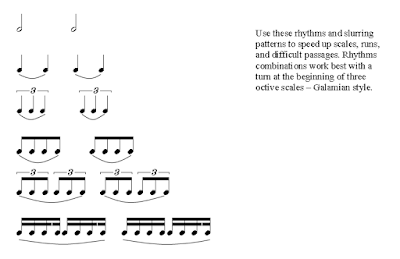
And for constant variation in think-time, use these for those scales, runs and those pesky Bach sections of perpetual motion...

Rhythm Variation
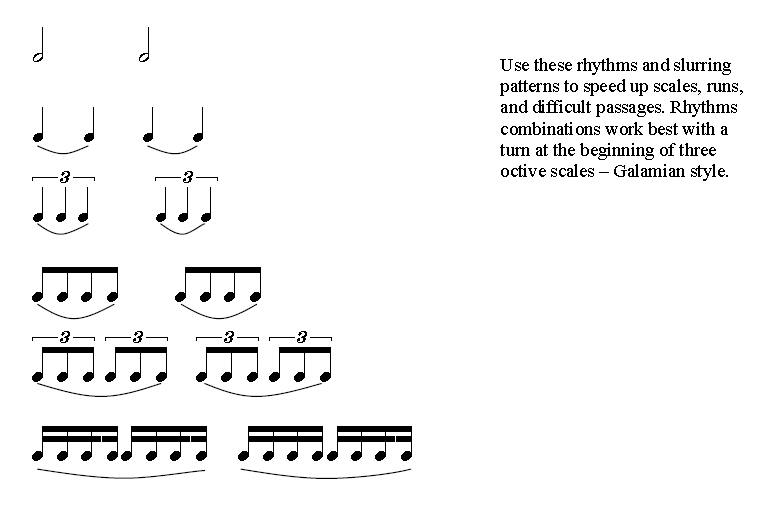
And for constant variation in think-time, use these for those scales, runs and those pesky Bach sections of perpetual motion...

When these get easy, add slurs.
Happy Practicing!
Subscribe to:
Posts (Atom)