Sunday, November 1, 2015

Neuro Music - A Tour of a Brain on Music

 “Hey! Look!”
“Over there!”
“Oooh… Look!”
“What is it?”
“How should I know?”
“What? You mean THAT?”
“Let’s ask Thy.”
“It’s Thy’s break time – better ask Hypo, he’s in charge tonight.”
“Hyp! Hey Hyp! Over here!” “Help us out Hypothalamus”
“What are all you crazy AP’s going off about? Don’t you know its break time?”
“Gee, Hyp, don’t blame us! We’re voluntary – she’s imagining this whole thing.”
“Right. Well – IT’S DARK! Stop it! You’re throwing off my circadian rhythm!”
“I think they are here for a tour…”

Sometimes my imagination gets the jitters at night. This particular incident that you are witnessing involves the rational for my obsession with music – and the neurological effects of music on education and disabilities. It’s a mouthful, isn’t it? What a crazy profession, music. I happen to be one of those believers who think every child can learn to make music, regardless of anything standing in their way; as a matter of fact, I have had a few things stand in my way. Enough for some folks to think I should not be standing here and enough for others to kindly deem me ‘persistent.’ But, hey! As long as we are here, why not join me for the tour of a brain on music?

“The tour, eh? Gee… well, I guess I could take you on the five-cent look around. Uh-Hmm. First, the introductions. I am Hypothalamus, in charge of the pharmacy and sleep… and a few other things, of course. Not many of us up here have simple jobs; why most of us have entire books – “

“Hyp, I think they are here for the music tour – you know, how music has affected our functions?”

“Right, thank you Glia. Now then, follow me… A few more short introductions while we walk – Neuroglia here works in communications, between synapses that is, along with the AP’s. The Action Potentials you already met. They keep this place bouncing. Glia, do try keeping those AP’s in their place. Somewhere they can’t distract me...”

“Ummm…”

“I know, not your job. Basal Ganglia hasn’t been keeping up with the demand for dopamine and serotonin, so Pre Frontal Cortex is running a little inattentively… along with a few of the other lobes. Well, Glia, we shall just do the best we can, and if I get off topic, just give me a zap.”

“Now that I can do.”

(If Hyp over there has lost you – I have ADD. ‘Inattentive’ does not mean I can’t focus; it means I focus on everything - so things stay pretty interesting around here. Synapses communicate through electrical signals, which neuroglia helps conduct; Glia is well acquainted with shocking intervention.) Hyp, where are we going?

“Glad you asked – the inner ear. No, we’re not ‘hear’ to see the stirrup and anvil – look past the cochlea. 
"See that big bundle of nerves? That is the auditory nerve; if we follow it, it will lead to the auditory processing center in the Temporal Lobe. The Temporal Lobe does the real hearing; the tympanic membrane can vibrate the inner ear bones in perfect synchrony, but until the AP’s travel the nerve synapses to temporal processing, our girl won’t hear a thing. In our case, everyone is doing their job, but the timing is off in processing somewhere. The big name for it is ‘auditory processing delay’ but some folks call it tone-deaf. A long time ago, our timing was way off; processing was so behind on pitch processing that pre-frontal was only getting messages like ‘kinda-high’ or ‘low-ish.’ Now you can hardly tell we have a delay.”

            Hey, Hyp - what changed? Why did the delay get… smaller?

“Why music, of course! ‘Frequency, Intensity and Duration,’ the recipe for neurologic expansion. The music lessons provided frequent stimulation for the auditory nerve, enough for Glia to start producing myelin and get the AP’s moving faster along the synapses. Of course, the intensity from Orchestra class increased the number a AP’s entering processing, and duration has been for – let’s see... four years old at the first lesson and now we are…”

Hyp!

“Oh, pardon me. Well, duration has been almost every day for… a lot of years. With that kind of detailed stimulation, auditory processing started building new pathways to sort out the information. After a while, pre-frontal was getting information detailed enough to attach labels to, like whole steps and intervals. Those pathways helped with language processing, too, helping us sort out sounds in the right order instead of backwards and upside down.”

(Dyslexia is one of the more noticeable ways my ADD manifests itself.)

“Music was just the stimulation temporal processing needed; why, if you really want to make our girl squirm, just play a pitch a quarter tone off from its diatonic buddies! All those years ago, she never would have noticed, and now it’s better than a bug on a bed post. No sir, this temporal processing unit can’t be called tone deaf anymore.  Now then, on to the Optic Nerve.

“The optic nerve is at the back of each eye, but crosses hemispheres before reaching the occipital lobe. Printed information being processed by the occipital center was pretty jumbled up in the beginning, and tracking was a foreign concept to them! Why I remember when the information occipital processing was sending to prefrontal could have been called modern art!”

“ZAP!” (That was Glia)

“Refocus! Once again, music provided the stimulation to help processing build the pathways they needed. Printed music does not change shape for different sounds, like an alphabet; it changes position. In essence, the contour of musical notation draws a picture of sound – ups and downs and jumps. With enough frequency, intensity and duration, occipital processing began connecting pathways with the temporal, and the shapes took on meaning. With sound association in place, left-to-right tracking became smoother. Eventually those pathways made the shift to more abstract sound associations and tracking – reading language. And thank goodness! Some of the skeptics were starting to wonder about us.

“One more stop. Command Central – the Thalamus. From here I wanted you to see the bigger picture, how music has changed our function on a larger scale. Music is one of the few elements of life that affects nearly every part of the voluntary nervous system – and a few of the involuntary nerves, but we won’t see those tonight. I have already shown you the connection between the temporal and occipital lobes. For an instrumental musician, they have been connected to the Parietal Lobe – Sensation Station. The parietal lobe processes the sensations felt in the hands and face, helping the cortex make adjustments in movement when needed. Parietal, Occipital, and Temporal are all connected to the Frontal Lobes. The motor cortex in the frontal lobes use the AP’s from sight, sound and touch to tell our hands (and faces of wind players) how and when to move. And let’s not forget the emotions expressed through music; those are provided by a network in the temporal lobe - the amygdala to be precise. The sequence of these connections is recorded in the cerebellum as a skill.
“Each lobe of the brain is connected to all the others. But for a musician, these connections happen simultaneously - in every part of the brain; frequently, intensely and for the duration of every practice session. Frequency, intensity, and duration, you will remember, are the recipe for building new pathways, strengthening and accelerating them. Each time a musician plays a note, the thalamus goes crazy relaying the messages that come from literally every direction. The thalamus of a musician gives new meaning to the concept of multi-tasking. When our girl plays music, these pathways light up with AP's brighter than a Fourth of July night sky. And that’s only the voluntary crew!

“The best part of all – I see you yawning, Miss ‘I don’t need a circadian rhythm’… right, back on track – is that all those interconnected and accelerated pathways support learning, memory, skill development, coordination, and information retrieval in every other discipline of life. The more pathways we build up here, the faster we can build another one. 

“Well, there you are. That’s my version of the music tour. Now go to bed! And your reader friend too. Before I call in the Pituitary Squad!”

~~~~~~

There it is – if I were to give up music now, I would be leaving behind the stimulation that built my white matter… and made me who I am. Music makes the brain a better place, and it gives the world a little more beauty – it expresses the beauty that should be. Music can be therapy, for learning disabilities, developmental delays, and so many other possibilities. Yes, every child can learn to make music and benefit from learning it. Maybe I’m in this crazy profession so a few children more can make some musical connections. 

For a well done video on this topic, check out this Ted-Ed Video

Wednesday, October 14, 2015

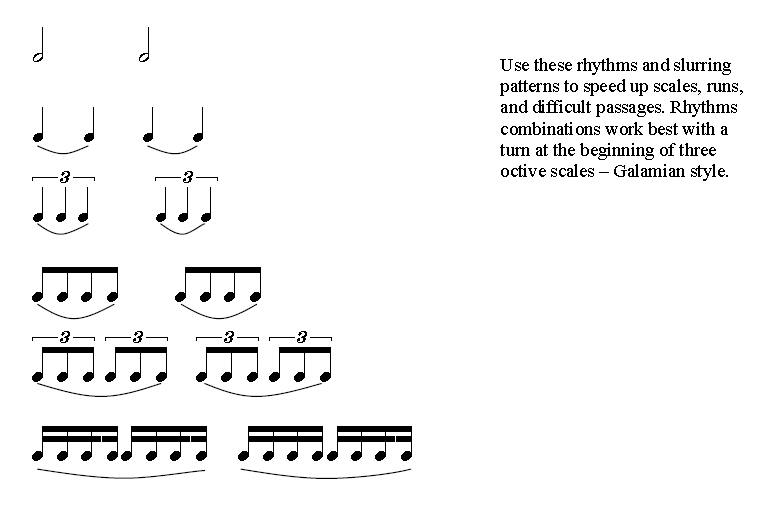
Rhythm Relays - Practice Rhythm Variation

While we are on the subject of practicing, here are some visuals of practice rhythms that can be used to give your practicing some novelty and turn your brain's auto-pilot off...

Rhythm Variation


And for constant variation in think-time, use these for those scales, runs and those pesky Bach sections of perpetual motion...


When these get easy, add slurs.

Happy Practicing!

Friday, August 28, 2015

Practical Practicing

Here are some practical ways to apply what we know about learning and myelination in the practice room. I am still working on formatting, so if something is not quite right, check out the PDF...

Practice Variations
Rhythm Mix-Up
To master difficult runs, play 4 note groupings with rhythms from box #2 of the ‘Rhythm Division’ sheet. By ‘pausing’ on one of four notes (the e.) , you allow your brain time to think ahead, while still practicing three notes in quick succession. After moving through all four rhythms, every note will have been practiced quickly (and slowly). Now you’re ready to play the run… as a run!


Finger-Bow Beat Exchange
Turn on your metronome. Hear your finger ‘plop’ into place on the first beat, bow the note on the second. It’s harder than it looks! (Rhythm is disregarded in this variation.)


Bow Rhythms
Play only the rhythm of the bow – on open strings without fingering. Slurs are key to the rhythm of the bow.


Straight Bowing
Remove slurs, hooks, etc. Play every note as it comes with a new bow. Focus on fingering and rhythm

Three Point Bow Relay
Play a section using only the lower half of your bow… only the middle… and finally, only the tip. Think Elbow and pinky (of your bow arm). Bow stoppers are helpful for this one.

Bow Flip
Play a passage with your bow flipped around – bow hold on the tip, frog in the air. Think bow hand forefinger, pinky and even speed.

Terrace Dynamics
With a practice mute on, play a chunk pp, then ff. Take the practice mute off and play the same chunk pp and ff. Without the practice mute, dynamics should be smoother and clearer (and more dramatic!). Now return to the marked dynamics of the music – exaggerate any changes between p and f. It should now be easier to switch between the two.

Practicing - The Myelin Way

Now we know how our brain learns and makes skills – by growing myelin through repetition. White matter and myelin are all very interesting, but now what? We need a practical application – how to apply what we know about myelin to our practice routines. Here are the practice guidelines I give my students: How to Practice – The Myelin Way.

(There is a link to a printable PDF at the end of this post… making a practice binder to keep handouts and music in can be a practical way to keep everything you have learned in one place.)

 Practicing – the Myelin Way

1.      Chunk It

Pick chunks of your music instead of playing straight through – 8 measures/2 phrases, TOPS. Remember - we are growing skills, not testing endurance.

2.      SLOWLY

“If you learn something slowly, you forget it slowly.” ~Itzhak Perlman

Get out the metronome and set it to mind numbing; turn it up after 3-4 repetitions of correctness.
Only turn the metronome up by one click at a time. You could be done after reaching 15 correct repetitions – or challenge yourself to 15 reps… all at different speeds! (Meaning, only count one of the reps from each metronome marking…)

3.      Repetitively -15X

“Knowledge is not skill. Knowledge plus ten thousand times is skill.” ~ Dr. Shinichi Suzuki

Keep track of how many times you play a passage/chunk – abacus beads, slide pennies across the music stand, ect. Fifteen times is the magic number – soon you will get to 10,000.
Remember, only the correct repetitions count towards your daily 15.

4.      With a Twist

Use practice variations to zero in on technique and keep your focus. Check the ‘Practice Variations’ sheet for ideas – like Rhythm Mix Up and Finger-Bow Beat Exchange.

5.      Consistency

5-6 days a week. “Practice only on the days you eat.” ~ Dr. Shinichi Suzuki
      (Notice, “5-6 days a week” …. we aren’t looking for burn-out)

50min on, 10min off ~ Itzhak Perlman     
This is some the best advise I’ve been given – let the fog clear!

Practice time can be spread out through the day – it doesn’t have to be done all at once.

Practice length is something to work up to; your teacher will help you gauge how long you should be practicing. Generally, we start with 15 min and work up in 5 min increments. For young students, that sometimes means 5 minutes, three times a day. Know your attention span.

6.      Self Awareness and Tools

Chunking repetitively and slowly can only accomplish so much. Self awareness is the ingredient that will ultimately turn practicing into the myelin and skills we want; only with self awareness are we able to adjust our playing and make sure the nerve we want to get myelinated – does!

Luckily, we now have some wonderful modern tools to help us develop our self awareness (yep, that must be grown too!). Most of these are now resources that can be obtained for free as an app online.

·         Metronome  -  You might think you are keeping a steady beat – until this gets turned on!

·         Tampura Box/Drone  -  This Indian instrument sounds different to our western ears, but is a wonderful intonation tool. Let it drone while playing scales and diatonic melodic sections of your repertoire.

·         Video recorder  -  Record short sections of your practice and immediately watch them. Mark your music with things you notice and then go back and fix them. There will be things you had no idea you were doing.

·         Tuner  -  Useful for tuning our instruments, as well as our ears. While playing scales SLOWLY, adjust each pitch to the tuner. This should only be done with scales – questionable pitches from repertoire selections can be checked with a tuner, but don’t play through passages matching the tuner (there is a complicated explanation for this – ask your teacher about overtones if you are curious). Listen for the tiny changes in ‘sound wobble’ patterns.

·         Mirror  -  Find a mirror to practice in front of. Watch yourself play and check things like: posture, bow hold and placement, straight bowing, straight wrists, etc. All those things teachers like to talk about in your lesson!

Happy Myelinating!

For a printable version of this guide, click: PDF - Practicing the Myelin Way

Monday, August 24, 2015

Practice, Practice, Practice! Growing skills is part of life – and Music.

Practicing is inseparably coupled with playing an instrument, but why? Somehow, we need to develop the skills to get the sound we want out of that instrument – so we can both enjoy our instruments and so the dog will stop howling at our attempts! But why does it have to be through practicing? “I played it right once… last week…” Sound familiar?

The goal of practicing is not to ‘play it right’, but to build skills – to teach our brain what to do. Fingers don’t play music. Our brain plays music with our fingers. That is a skill.

The human cortex is one of the most fascinating features of human anatomy. If white matter is less than intriguing to you, keep going. Maybe my sheer delight will be contagious. 

The cortex is home to language, abstract thought, movement and a host of other skills that fill our everyday lives.[1] But these cortex-tual skills are not inherent or automatic; they must grow.[2]

I would like you to meet Myelin. She is the stuff skills are made of.


Myelin works with nerves to create skills. Every time a nerve in our brain ‘fires’, myelin grows around that nerve. That is why the neuron looks like tree rings are growing around it – the myelin is growing around the nerve every time it fires. The myelin blanket makes the nerve stronger and faster.

Everything we do starts with a nerve synapses. In order for us to make a sound (verbalize) or walk down the street (movement), the cortex must stimulate an action potential in a nerve, telling our bodies what to do. The same thing must happen for us to hear a bird sing, or to see a sunset – only the stimulation for these action potentials come from a stimulus outside our bodies. Whether the stimulus comes from our own determination or the bird singing on the lawn, myelin is there to wrap the nerve and make it stronger.


Where myelin grows, a skill is being created. The skill to walk is born every time a toddler takes another step – the walking nerves are getting myelinated. The skill to speak, read, write, ride a bike, sing and play the piano are all born with the myelination of neurons. Yes, even the skill of hearing smaller and more precise sounds can be myelinated.

But myelin only grows when the nerve fires, and then only a tiny bit. To make the nerve stronger and faster, the nerve must be fired over and over (repetition, repetition!).  After many repetitions of an action, the myelin becomes thick enough to act as ‘electrical insulation[3].’ The thicker the myelin sheath, the stronger and faster the skill.

This means incredible things for our practicing! Since we fire our ‘music nerves’ when we practice, we can build the skills we need by playing repetitively and growing myelin. Dr. Shinichi Suzuki knew how important repetition was when he wrote, “Knowledge is not skill. Knowledge plus ten thousand times is skill.[4]

Now growing myelin can mean growing some awesome skills. But that also means we can grow some pretty awful habits. If we practice correctly, the ‘right’ nerve gets myelinated; if we practice incorrectly – maybe with sloppy technique or rhythm that clashes with the synchrony of the universe – that nerve gets myelinated. Now the wrong nerve is stronger and faster than the nerve that plays beautiful music. Which nerve do you think will win? 

Practicing correctly can be a big challenge; how can we possibly keep from accidentally myelinating the wrong nerves? Itzhak Perlman has the answer to that: practice slowly. “If you learn something slowly, you forget it slowly.” By practicing slowly – sometimes painfully slow – we give our fingers and brain enough time to find the right nerve. A myelinated nerve forgets very slowly.  (You can hear Mr. Perlman talk about practicing here )

So it's true: only perfect practice makes perfect. And now you know why.

Let’s go practice! … I mean, myelinate!


[1] Doman, Glen. ‘How to Teach your Baby to be Physically Superb.’ Better Baby Press, 1988.
[2] Coyle, D. ‘The Talent Code.’ New York, NY; Bandon House, 2009.
[3] Coyle, D. ‘The Talent Code.’ New York, NY; Bandon House, 2009.
[4] Suzuki, Shinichi. ‘Nurtured by Love.’ 

Tuesday, April 1, 2014

Private Lesson Guide and Policy

Lessons:

I teach private lessons on violin, piano, viola and cello. Lessons are $30 for a half hour lesson, or $60 for a one hour lesson (ask about sibling discounts!). Lessons are held in NE Salem (OR). Send me a message with any questions and for lesson availability - and to sign up for lessons!

As a classically trained violinist/pianist, I structure lessons based on the Suzuki model, while also incorporating other pedagogic ideas and literature. Learning style is also an important aspect of music education, and I modify and personalize lessons based on the individuals needs and learning style.

Private Lesson Policy:

Tuition: Monthly tuition is due in full on the first lesson of every month.
           Tuition = $30/30min, $45/45 min., $60/hour, X how many weeks there will be in the month.

Cancellations: In the unforeseen event that you are unable to be at your lesson, please call or text to cancel before your lesson time.  One cancelled lesson per student per month will be credited to next month’s tuition if it is cancelled ahead of time.  [If you have to cancel more than one lesson, you will have the opportunity to make them up at the end of the month]

In the unforeseen event that I must cancel a scheduled lesson, it will be credited to next month.

Monthly tuition will be pro-rated for holidays and pre-planned absences (such as travel plans)

Missed lessons that were not cancelled will not be credited or made up. (Contrary to urban myth, musicians sometimes like to cook dinner, etc. when their schedule permits - which isn't very often.)

The Mandatory Bio...

A music teacher must have a bio - or so I've been told. So here it is, in 3rd person and everything!

Ms. Rosberg is a passionate music teacher, violinist, and pianist. Her violin education includes studies with Diane Allen and Casey Bozell. Symphonic works being a staple of her music diet, she played viola with the Butte (MT) Symphony and more recently, violin with the Central Oregon Symphony.

As a teacher, Serianna is passionate about the developmental benefits music can have on every child, regardless of age, ability, or perceived 'talent.' Every child can learn music, and every child can benefit from musical activities. She has been teaching since 2005.

Serianna is a graduate of Corban University, where she received summa cum laud her BS in Music with a minor in Biblical Studies. In addition to her traditional education, she is also Suzuki trained and 'Every Child Can' certified.